- February 1, 2026
- Posted in Advice & News
Aluminium vs uPVC Windows: Which Is More Durable?
Both aluminium and uPVC windows are durable in UK conditions when properly specified. Aluminium typically lasts 30+ years with superior structural performance, whilst uPVC offers 20–30 years of excellent moisture resistance at a lower cost.
Replacing windows often comes with mixed advice about which material really lasts. In practice, durability comes down to how well a window copes with everyday UK weather over time. Both aluminium and uPVC can perform well when chosen properly, depending on size, exposure, budget and property type.
Key Takeaways
- Modern aluminium windows typically last 30+ years with proper thermal breaks and quality coatings, offering superior structural performance for large openings and coastal properties when specified with marine-grade finishes.
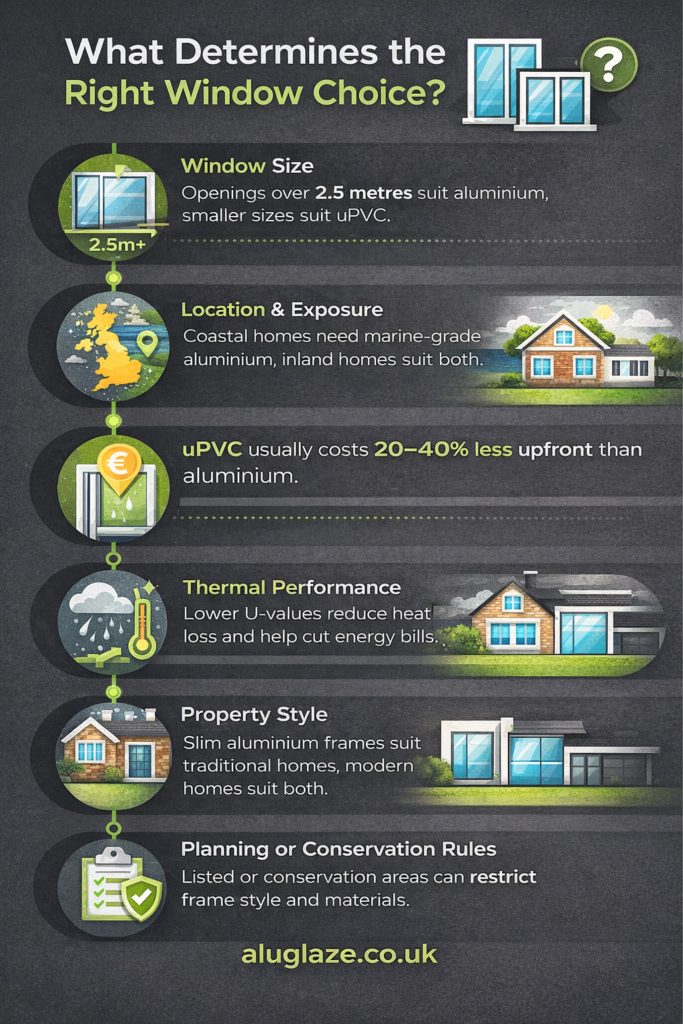
- uPVC windows generally last 20–30 years with excellent moisture resistance and lower upfront costs (typically 20–40% less than aluminium), making them ideal for standard residential sizes in sheltered locations.
- Durability depends more on proper specification and professional installation than material choice alone. Both materials must meet UK Building Regulations Part L U-value limits (1.4 W/m²K for replacements) and be installed by FENSA-registered professionals.
What Durability Means for Windows
Durability goes beyond how long a frame physically exists. It includes:
- Structural stability over time
- Resistance to moisture, wind, and UV exposure
- Long-term thermal performance
- Seal and gasket reliability
- Maintenance requirements
A window that warps after ten years or develops condensation issues after five is not durable, even if the frame remains intact.
UK Building Regulations Part L sets performance standards with U-value limits of 1.6 W/m²K for new dwellings and 1.4 W/m²K for replacements. Meeting these limits reduces condensation risk and thermal stress, directly affecting lifespan.
Both aluminium and uPVC can meet these standards, but they achieve insulation differently. Aluminium relies on thermal breaks, while uPVC uses multi-chambered profiles.
How UK Weather Impacts Window Durability
UK weather plays a bigger role in window durability than most people realise, from salty coastal air to heavier rainfall and storms, which the sections below break down clearly by exposure and condition.
Window Performance in Coastal Areas
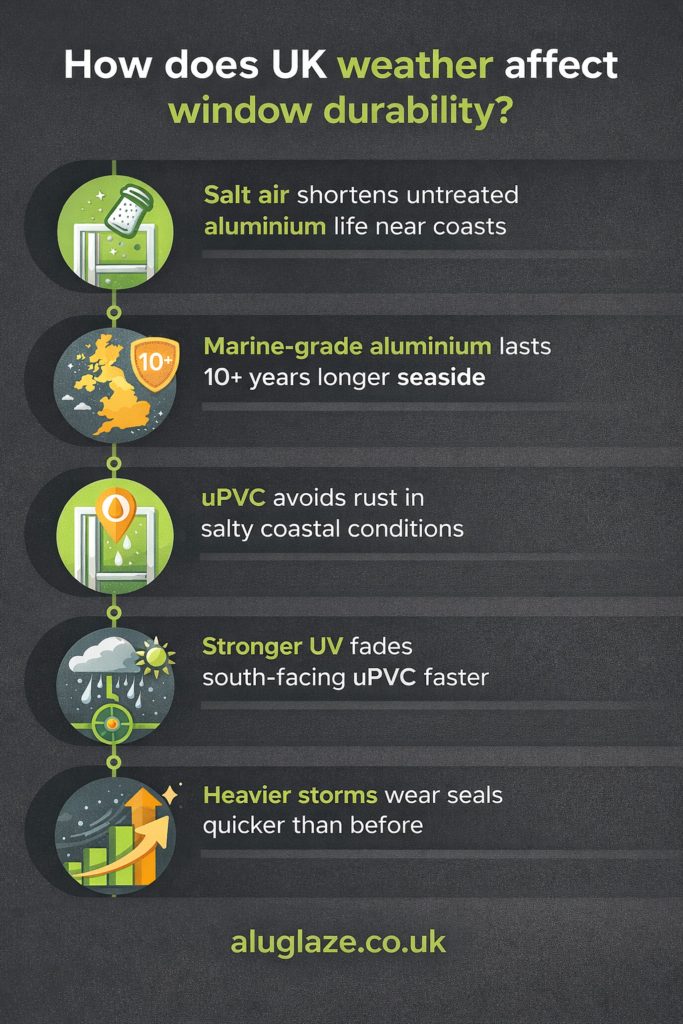
Coastal properties face salt spray corrosion and higher wind loads than inland locations.
Aluminium requires marine-grade powder coating or anodising in coastal zones. When properly specified, it performs excellently even in harsh seaside conditions. Standard powder coatings will eventually show pitting in severe coastal exposures, which is why specification matters so much.
uPVC is naturally resistant to salt corrosion and will not rust or pit. It can face faster UV degradation in south-facing exposures though, particularly in reflective coastal environments where sunlight bounces off water and intensifies UV exposure.
UK sea levels have risen roughly 19.5 cm since 1901, with two-thirds of that rise occurring in the last 30 years. This increases coastal exposure severity and makes proper specification more critical than ever.
Window Durability in Heavy Rain and Storms
Climate change has increased storm rainfall intensity by around 15% in recent extreme events.
Both materials handle rain well, but drainage design matters enormously. Aluminium frames typically have better engineered weep holes with precision milling. uPVC relies on adequate chamber drainage, which works well when profiles are properly designed.
More frequent intense rainfall stresses seals and gaskets. Quality of installation matters more than material choice here, as poorly fitted windows of either material will leak when drainage paths become blocked or seals compress unevenly.
UK climate projections show winter rainfall could increase up to 30% by 2070 in some regions, making robust drainage and sealing essential for long-term performance.
Aluminium vs uPVC Window Frame Strength
Aluminium is dimensionally stable and does not warp, rot or absorb moisture, which makes it ideal for large openings and slim frames. When clients ask us about wide spans, bi-fold doors, or exposed elevations, we often recommend our aluminium windows because their rigidity and long-term shape retention make a real difference over decades.
uPVC is also highly moisture-resistant and suits the UK’s damp climate well, using reinforced multi-chambered profiles for strength. It performs reliably for standard window sizes, though it can flex under heavier loads.
Aluminium’s rigidity makes it better for wide spans such as bi-fold doors, while uPVC suits typical residential openings.
Both materials’ structural performance depends heavily on profile quality and installation. A poorly installed aluminium window will fail faster than a well-installed uPVC one, which is why FENSA-registered installers matter so much.
Aluminium vs uPVC Window Lifespan in the UK
Aluminium windows typically last 30 years or more when properly specified, with coating quality and thermal break design playing a major role, especially in coastal areas where marine-grade finishes resist salt exposure well.
uPVC windows usually last between 20 and 30 years when well made and fitted, with modern UV stabilisers reducing early ageing, though surface wear can appear after decades in strong sun.
Both lifespans rely heavily on professional installation to Building Regulations standards.
Warranties of 10–20 years often reflect product quality, while real longevity depends on exposure, maintenance and overall thermal design.
Aluminium vs uPVC Window Maintenance Requirements
| Maintenance Task | Aluminium Windows | uPVC Windows |
|---|---|---|
| Cleaning | Annual wash with mild detergent | Wipe-clean surface, annual wash |
| Drainage | Check weep holes annually, clear debris | Check drainage chambers annually |
| Seals & Gaskets | Inspect every 2–3 years, replace if worn | Check annually, replace if perished |
| Moving Parts | Lubricate hinges annually | Occasional silicone lubricant for hinges/handles |
| Repainting | Not required (powder coating lasts decades) | Not required |
| Professional Service | Annual check recommended if under warranty | Annual check recommended if under warranty |
Both aluminium and uPVC are low maintenance compared to timber, though aluminium needs slightly more care around hinges and locks in return for frames that barely degrade over 30+ years.
uPVC usually needs little beyond cleaning and minor adjustments, making routine upkeep easy to stay on top of. For homeowners prioritising cost efficiency and low maintenance for standard openings, we regularly install our uPVC windows as a dependable long-term solution that performs well in typical UK conditions.
Energy Efficiency and Window Durability
Energy efficiency and durability are related but separate considerations.
Both materials can achieve excellent U-values of 1.4 W/m²K or better for replacement windows when properly specified with quality glazing. The key is understanding that thermal performance protects durability by minimizing condensation risk and thermal stress.
Aluminium requires thermal breaks to meet modern energy standards. Poor thermal design leads to cold bridging, which causes condensation and accelerated seal failure. A thermally broken aluminium frame with quality double or triple glazing easily meets Part L requirements.
uPVC is naturally insulating because of its multi-chambered profile design. Whole-assembly U-value still depends on glazing unit quality and frame design though, not just the inherent properties of the plastic.
Meeting Part L requirements protects long-term durability by reducing fabric stresses and moisture accumulation. A window operating at the wrong temperature differential will develop condensation, which damages seals, encourages mould growth, and eventually compromises structural integrity.
BRE’s technical guidance on U-value calculations provides the methodology for whole-assembly assessment. Accurate calculation including frame corrections and edge effects is crucial, as a poorly specified frame can add several tenths W/m²K to installed performance.
Aluminium vs uPVC Windows: Which Material Suits Your Property?
When Aluminium Windows Are the Better Choice
- Large openings and bi-fold doors
- Coastal or high-exposure locations
- Slim sightlines and modern designs
- High-traffic or commercial use
When uPVC Windows Are the Better Choice
- Standard residential window sizes
- Budget-led projects
- Sheltered locations
- Low-maintenance priorities
Common Myths About Window Durability
Window durability is surrounded by half-truths and outdated ideas, so the following points tackle the most common myths head-on, separating what really matters from assumptions based on old products and poor installations.
Do aluminium windows corrode?
Modern aluminium does not corrode in the way steel does, as it does not rust. Powder-coated or anodised finishes protect the surface for decades, even in harsh environments. In coastal areas, marine-grade coatings are used, allowing aluminium frames to last 30+ years when correctly specified.
Do uPVC windows crack or warp over time?
Quality uPVC with UV stabilisers rarely cracks in normal UK conditions. While slight surface chalking can appear after decades of strong sun, this is cosmetic rather than structural. Modern reinforced profiles resist warping well when properly installed and sized.
Are aluminium windows cold?
Older aluminium frames without thermal breaks were prone to heat loss and condensation. Modern thermally broken aluminium meets current U-value standards and prevents cold bridging. When paired with suitable glazing, aluminium can match uPVC for thermal performance without feeling cold to the touch.
Do uPVC frames yellow or discolour?
Modern uPVC uses advanced stabilisers that prevent yellowing seen in early products. White frames from reputable manufacturers remain stable for decades in UK conditions. Discolouration today is rare and usually linked to poor-quality formulations rather than the material itself.
Aluminium vs uPVC Window Performance Comparison
| Performance Factor | Aluminium Windows | uPVC Windows |
|---|---|---|
| Typical Lifespan | 30+ years | 20–30 years |
| Structural Rigidity | Excellent (ideal for large openings) | Good (reinforcement needed >1.5m) |
| Moisture Resistance | Excellent (will not rot or absorb water) | Excellent (impervious to moisture) |
| Coastal Durability | Excellent (with marine-grade coating) | Good (naturally corrosion-resistant) |
| UV Resistance | Excellent (powder coating very stable) | Good (modern stabilisers effective) |
| Thermal Expansion | Minimal | Moderate (requires installation tolerance) |
| Maintenance Level | Low (annual cleaning, periodic checks) | Very low (minimal intervention needed) |
| Upfront Cost | Higher (baseline for comparison) | Lower (typically 20–40% less) |
These comparisons represent quality products from reputable manufacturers installed to Building Regulations standards. Performance varies with specification quality and installation workmanship.
Conclusion
Both aluminium and uPVC offer solid durability when properly specified. The right choice depends on window size, exposure, budget and the character of your property, rather than assumptions about one being better than the other. Installation quality and U-values matter just as much as frame material.
At AluGlaze, we supply and install both systems and help you choose what truly suits your home. Contact us today for a free quote and specification assessment.
FAQs
How long do aluminium windows last compared to uPVC?
Aluminium typically lasts 30+ years with proper maintenance and quality coatings, while uPVC generally lasts 20–30 years. Both lifespans assume professional installation and appropriate specifications for your exposure conditions.
Which is better for coastal properties?
Both can work in coastal areas, but aluminium with marine-grade powder coating or anodising typically outperforms in salt-spray environments. uPVC will not corrode but may experience faster UV degradation. Proper specification matters more than material choice.
Do aluminium windows meet UK energy efficiency standards?
Yes, modern thermally broken aluminium windows easily meet Part L Building Regulations U-value limits of 1.4 W/m²K for replacements when correctly specified with quality glazing units.
Is uPVC cheaper than aluminium in the long run?
uPVC has lower upfront costs, typically 20–40% less, and minimal maintenance costs. Aluminium costs more initially but can last longer with virtually no degradation, potentially offering better value over 30+ years in demanding applications.
Can I mix aluminium and uPVC windows in the same property?
Yes, many homeowners use aluminium for large openings like bi-folds and picture windows where structural performance matters most, and uPVC for standard casement or tilt-turn windows where cost efficiency is preferred.
Sound good?
Get in touch on 0113 519 5507 to talk about your front door replacement.